
UK DARIAH Day 2025 - Imagining Future Digital Research Infrastructures

The second UK DARIAH day was hosted by the Edinburgh Futures Institute (University of Edinburgh) on Friday 7 November, in collaboration with the five other UK DARIAH partners (King’s College London, University of Brighton, University of Exeter, University of Leeds and the School of Advanced Study, University of London). The event explored the futures of digital research infrastructures in the arts and humanities, with a focus on the current and potential relationships between UK and European infrastructures. It was supported by DARIAH-EU, DISKAH, and the Centre for Data, Culture & Society.
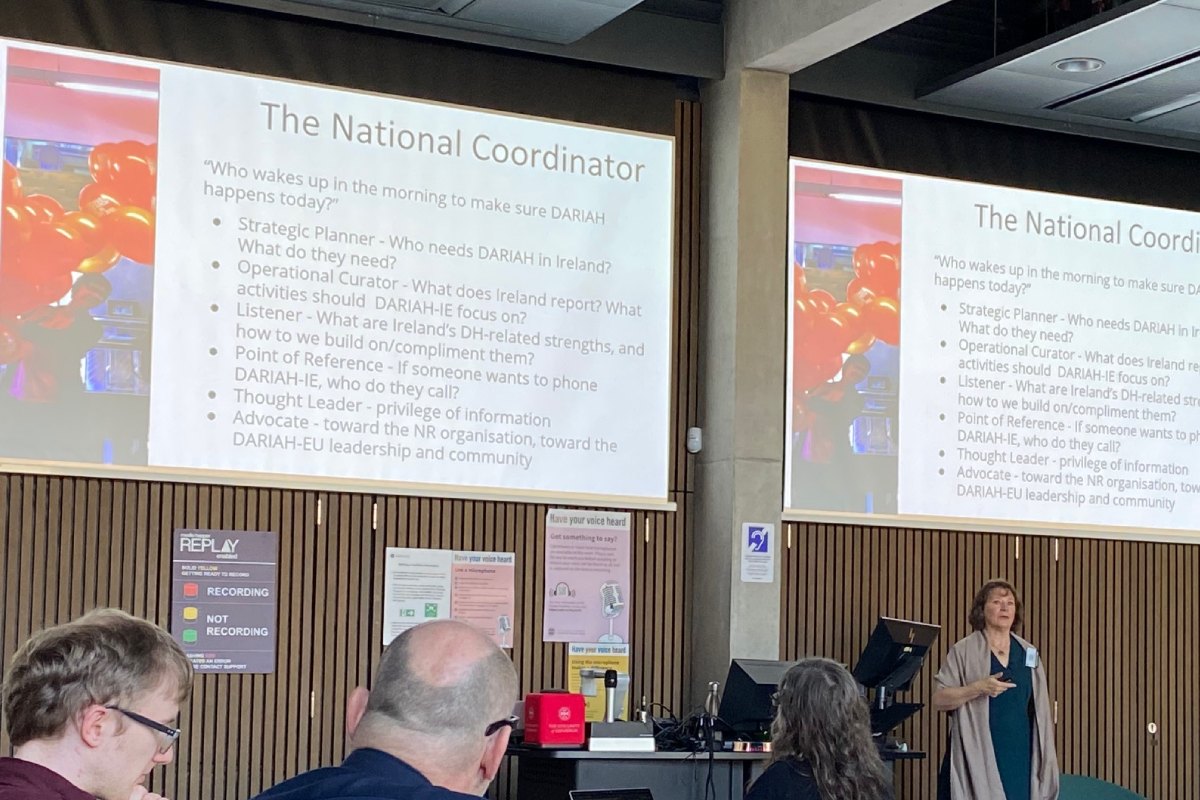
Jennifer Edmond (DARIAH Ireland/Trinity College Dublin) began the day with a keynote that drew on her personal history of engagements with DARIAH across her career to illustrate the crucial impact research infrastructures can have on individual career trajectories. As the current National Coordinator for DARIAH in Ireland, Edmond’s talk demonstrated how effective infrastructure relies on the humans who guide individuals to understand their own potential pathways into larger scale infrastructures and who act as the crucial connective tissue between local, national and international levels.
Edmond’s talk was followed by Sally Chambers’ (DARIAH/British Library) wide-ranging exploration of the different national and regional models of DARIAH membership, demonstrating the importance of adapting models to local contexts and existing national infrastructures. The CLARIAH model used in a number of countries such as Spain and Austria was highlighted, which seeks to combine the strengths of the two most significant European humanities infrastructure projects DARIAH and CLARIN (the Common Language Resources and Tools Infrastructure).
Speakers leading UK-based digital research infrastructures presented on the aims and focus of a series of distinct yet complementary initiatives. William Nixon from Research Libraries UK (RLUK) discussed their new strategy that seeks to further the organisation’s emphasis on collaboration, open research and digital scholarship. André Piza (Turing) shared work commissioned by the AHRC-funded DataCulture project and undertaken with David Beavan (Turing), Arianna Ciula (KCL) and many others to develop a roadmap for national research software engineering capability in the arts and humanities, in recognition of the ever increasing need for greater collaboration between RSEs and humanities researchers. The final two morning presentations from Karina Rodriguez Echavarria (Brighton) and Eamonn Bell (Durham) focused on AHRC/UKRI-funded initiatives to strengthen training and community-building in relation to high performance computing in the arts and humanities. The DISKAH (Digital Skills in Arts and Humanities) fellowship programme is developing a cohort of arts and humanities researchers engaged in large-scale computational methods, while the CCP-AHC (Collaborative Computational Project for Arts, Humanities and Culture) is focused on the sustainable development and discoverability of software, pipelines and workflows for arts and humanities research.
The discussion following the morning’s presentations reflected on the diverse possible future routes to strengthening the connections between UK and European digital research infrastructures. Given the existing digital research connections between the UK and Ireland, particularly through the UK-Ireland Digital Humanities Association, Edmond highlighted the potential for exploring a UK-Ireland regional DARIAH coordination model with an emphasis also on strengthening collaboration across the UK’s four nations.
Over lunch, a community-led showcase featured posters and presentations on a rich variety of activities and contributions from DARIAH UK cooperating partners and beyond. These ranged from discipline-specific initiatives (e.g. a project on digital literary studies) to cross-disciplinary publication and training platforms (e.g. Journal of Open Humanities Data, RESHAPED), and from national mapping exercises of infrastructures to underpinning practices of software engineering processes and infrastructures connected to digital accessibility.
In the afternoon, David Selway spoke on behalf of the iDAH (Infrastructure for Digital Arts and Humanities) programme at the AHRC on their current approach to digital research infrastructures. His talk demonstrated the breadth of recent investments, such as the RICHeS (Research Infrastructure for Conservation and Heritage Science) programme, the Enact Practice Research Data Service and support for the work of the Software Sustainability Institute. Selway emphasised the ongoing nature of the programme and the importance of consultation with the community on its future shape and development.
The final workshop session of the day provided space for collective imaginings of future digital infrastructures. Drawing from their project on Infrastructure Futures for Digital Cultural Heritage, Melissa Terras and Jen Ross (Edinburgh) encouraged us to be hopeful and creative in our infrastructure discussions. Workshop participants were given the opportunity to discuss a selection of thought-provoking scenarios as prompts for reflecting on the current and future design of digital infrastructures. The workshop highlighted the diversity of potential infrastructure futures and the value of speculative design in prompting us to think beyond existing models and constraints.
In sum, the day provided a valuable opportunity to reflect on both existing digital infrastructure developments and to imagine potential futures. The day’s talks demonstrated the breadth of recent infrastructure investments in a range of digital research initiatives for the arts and humanities in the UK. From an open research perspective, the event reinforced the view that openness, interoperability, and recognition for data and software work are foundational to building sustainable and connected digital research infrastructures. At the same time, discussions throughout the day foregrounded the importance of the interconnectivity of infrastructures and of events like the DARIAH day for strengthening and forging connections. For just as we need to think beyond local institutional infrastructures in our national context, we must also be conscious of the risks of nationally siloed infrastructures and of the ways knowledge sharing and connections at the international level can further amplify the impact and reach of the UK’s digital research infrastructures.